
 |
The dental implant is "fixed" to the jawbone by a process call osseointegration which means bone directly in contact ("integrated") with the metal and hence is able to take the load of chewing without it losing its strength and dropping out. It is likened to a lamp post cemented onto the ground which will stay firm even when a car crashes onto it at high speed to the extent it wraps around the post. It may not last forever but it will last a long time and studies have shown that dental implants could last for 20 years or more. |
 |
Implant surgery is generally very safe and hence it can be done at the general dentist office for the straightforward cases. In special circumstances where there is inadequate bone height on the lower jaw, there is a risk of damage to the sensory nerve though in experienced hands, this is quite rare. Perforation into the maxillary sinus can occur in the upper jaw and non integration resulting in loss of the implant eg in smokers can happen. In the major implant cases where there is a need for bone graft, loss of the bone graft due to infection can also happen. Generally in experienced hands, complication rates are low. |
 |
Just like motorcars where there are many choices, there are close to a few thousand brands of dental implants and many new ones coming out from places such as China. Of all these different makes, only a small handful ( 5 or so) have long term clinical studies published backing up their claims in osseointegration and efficacy. These few companies have strong research divisions that constantly improve on their products and certainly can be considered as more reliable in terms of clinical effectiveness. Individual dentists have their own choice of dental implants. In our clinic we use mainly top European and Korean implants which are among the few companies with strong clinical research background. Click on Astratech Dental, Straumann ITI, NobelBiocare, Dentium and Osstem. |
 |
Dental implants will definitely cost more than making a set of dentures but in the long run, it is not more expensive than having bridges which has the problem of possible damage to adjacent teeth which may require extraction and redoing the bridge. On average, a dental implant can cost from $4000 to $5000 or more depending on the type of implant used (see below), the difficulty of the case and skill of the surgeon. Medisave claims are allowable for the surgical part of the procedure and claims up to $1850 may be obtainable. In the case of bridges or dentures, Medisave claims are not allowed. Mini implants are recommended only for some special cases though they are cheaper and may costs only $500 to $1000 |
 |
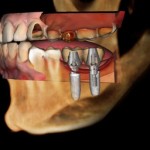
Dental Implants can be used to help support a denture and improve retention, especially on the lower jaw. Again, a clinical assessment is essential to determine if the case is suitable for an implant retained denture. |
 |
Missing teeth do not necessary has to be replaced one for one with implants. Sometimes, the specialist dentist may decide that an implant bridge will be sufficient for biting strength. The amount of bone present also determines how many implants can be placed but bone grafting by the specialist surgeon can be done to improve the bone volume. It is dependent on a clinical assessment that can be provided by our clinic. |
 |
As long as someone is fit enough to have dental extractions, he/she will likely be suitable for dental implant surgery. Smoking, diabetes and osteoporosis may affect the osseointegration rate and need expert management. Like the foundation of a house, adequate bone volume is essential for dental implants. After extractions, bone is thinned down naturally and hence it is advisable to preserve as much bone as possible. (see below) In cases with deficient bone such as the lower jaw or near the maxillary sinus, the surgeon may need to do bone grafting and sinus lift to increase the bone volume. (see below) Good oral hygiene and dental care is essential for successful dental implant therapy. |
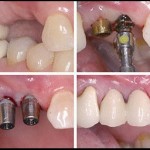 |
Basically it is like building a house. Firstly one needs good foundation which is the ground is firm (ie sufficient good quality bone). The first stage then involves piling to provide the structure for the building. The surgery to place the dental implant is like piling before a building is constructed. After the surgery, the implant is left to heal inside the jaw bone. The second / final stage involves construction of the building ie placing the implant crown which is the artificial tooth. In summary, 2 stages is often needed ie surgery to place the implant and then restoration with putting on the tooth. In some cases, immediate implant can be placed into the socket just after an extraction but the skill of the surgeon and the choice of the case becomes very important for its success. |
Talk to our friendly staff for questions and enquiries regarding our services
Contact Us Now
Dr Victor Fan
MB BCH; BAO (UK)
BDS (Singapore)
FDSRCS (England)
FRCS (England)
FRCS (Intercollegiate)
FAMS
FICS
6 Napier Road
#07-03 Gleneagles Medical Centre
Singapore 258499
Phone:
+65 64722982
Fax:
+65 64722782